Developing a rural jobs platform for Northumberland
Across rural Northumberland, employers and residents face a shared challenge: How to connect people who would benefit from working, with businesses that need local employees.
While unemployment numbers are one part of the story, the higher priority for us is to help people who would thrive in employment, if the right opportunities and support were in place.
The project is being supported by Northumberland County Council’s RAMP funding, and includes a wide range of stakeholders within the employment and business support ecosystem.
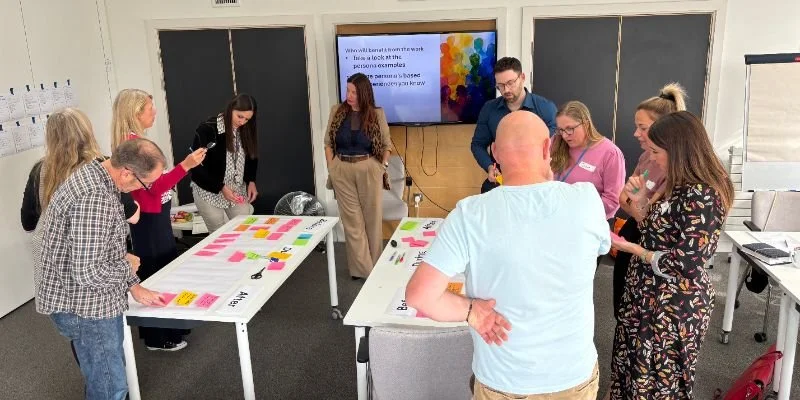
Workshop with a range of stakeholders in employment and business support.
What we’ve discovered so far
Our early conversations with employment hubs, colleges, community organisations and local businesses have revealed some key insights:
Work isn’t always visible
Many jobs exist that people simply don’t know about. The language used in job titles often makes roles sound inaccessible, even when people already have the skills to do them.
Similarly, employers are struggling to fill posts in areas like welding, care and hospitality, but these vacancies aren’t always well-advertised or connected to training routes.
Work experience can be patchy
Education providers are offering very different models of work experience, and in many cases the opportunities are shrinking.
For young people in rural areas, that first chance to explore the world of work is becoming harder to access.
Employers are cautious
Some SMEs are reluctant to hire people without work experience, citing poor attendance and retention in the past. Others struggle to adapt roles to fit rural realities, such as seasonal work or limited public transport.
Transport is the constant barrier
Time and again, transport comes up as the biggest challenge. Buses don’t align with shifts, rural routes are patchy, and alternative solutions like community transport or car sharing aren’t easily built into the job-seeking process.
Support must be wrap-around
Hubs across Northumberland show that getting into work often isn’t just about finding a job. People may also need help with debt advice, confidence building, digital access, or even just time and space to apply. Employment support that combines practical tools with human guidance works best.
Housing is also an issue
In some rural areas, there isn’t accommodation options for people wanting to relocate near a job opportunity. House and rental prices out of reach for some people, and in some instances, there just isn’t any housing available.
Where the project is heading
The platform we’re developing won’t replace existing services. Instead, it will join them up – providing a clear, user-friendly route through the system for people who might otherwise fall through the gaps. Some of the ideas we’re exploring include:
Skills- and interest-first search
Where people can describe what they’re good at and interested in, and the platform suggests roles and training opportunities as next steps they might not have considered.
Transport integration
So that when someone sees a job listing, they can also see how (or if) they can realistically get there.
Employer support tools
To help SMEs write accessible job descriptions, plan recruitment, suggest transport methods and improve retention.
Inclusive access
With options beyond digital-only services, recognising that not everyone in rural Northumberland has reliable internet or devices.
Why this project matters
This project is more than just a jobs board. It’s about trying to address deep-rooted rural challenges in isolation, underused skills, and to connect services, employers and potential employees.
Social impact
Measuring the social impact is central. We’ll be looking at:
How many economically inactive people move closer to employment
The extent to which SMEs feel more confident hiring locally and inclusively
Improvements in collaboration between community groups, training providers and councils
Wider benefits such as improved wellbeing, reduced travel barriers, and stronger local economies
By designing this platform with people from rural communities, employers and service providers, we’re trying to create not just a tool, but an ecosystem that supports rural work in a practical, measurable way.