Project update: Rural Jobs Platform
It started with a study
Starting earlier in 2025 with a feasibility study, Paul Cowie (CEO of Rural Design Centre) undertook some research into the difficulties people living in rural areas face when moving from not working into employment. Alongside this, he investigated the challenges faced by rural businesses when recruiting staff.
Following the study, we have worked on developing a platform that could help bridge the gap between unemployed people in rural Northumberland and businesses who need to recruit.
We kicked off in August, by identifying people working in employment and business support, then arranged a series of interviews to dig a little deeper into the challenges that were being faced.
Interviews, then a workshop (of course!)
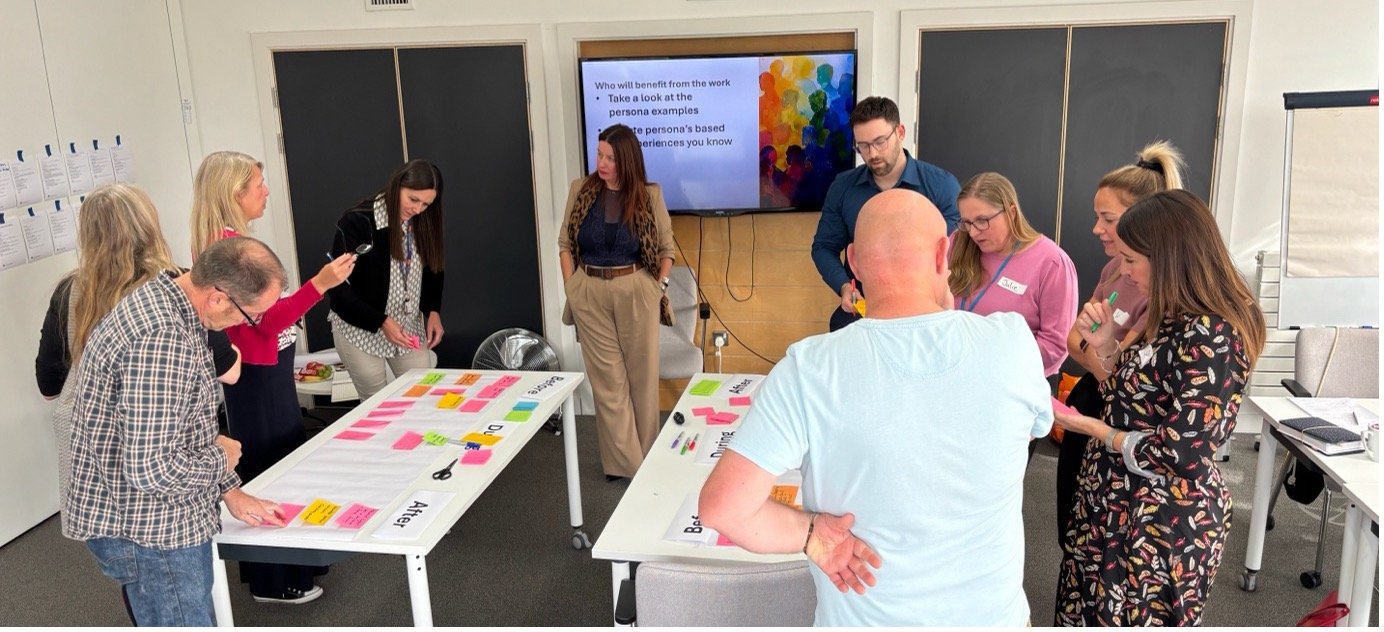
The interviews were quickly followed by an in-person workshop, which was attended by people from across the ecosystem — employment and business support, private sector recruitment, economic development and the voluntary community sector.
The workshop was a safe space for us all to dig deeper into this problem and work out where the project could have the greatest impact.
During the workshop, we ran various activities, including service mapping, persona creation and future state journey mapping.
We had planned to do some prioritisation and rapid prototyping as well, but the conversations were so in depth during the first part of the workshop, we ran out of time, so followed up afterwards and ran these activities online in the following week.
Lots of good things already happening
It quickly became apparent that there is a lot of good stuff going on to support helping people into employment. We certainly didn’t need to duplicate any of that, but rather we’d be better focusing on supporting the people already doing the great work on the ground.
One idea was to work on something to help join-up all that support work going on across Northumberland. Another was to work on supporting SMEs to recruit within rural areas more effectively.
What can we develop to add value?
In the weeks following the workshop, the conversations continued and led us to start developing a few ideas that could potentially help. These were:
Support Services Directory
Skills Needs Coordinator
Inclusive Job Advert Assistant
Job Matcher
Support Services Directory
As there already are a lot of amazing people and organisations supporting unemployed people through the various stages of moving from not-working to working, we surmised that something to help join up all that support work could potentially help.
Ahead of the workshop, we mapped all the employment support services that we could find in and around Northumberland. Then, during the session, we displayed them on cards, with the idea that anything missing could be added, and anything that wasn’t accurate or wasn’t current, could be updated or removed from our mapping.
It turns out that a directory like this already existed in the form of a spreadsheet and was being regularly updated by some of the key players in employment support — people at Northumberland County Council and Northumberland Community and Voluntary Action.
When anyone in the employment support ecosystem needed to access the information, they would ask for the latest spreadsheet to be shared via email.
We took that spreadsheet, and turned it into a searchable and filterable directory, which will save the job of someone sending that updated spreadsheet out, as well as resolving the issue of inaccurate and outdated spreadsheets being out in the wild.
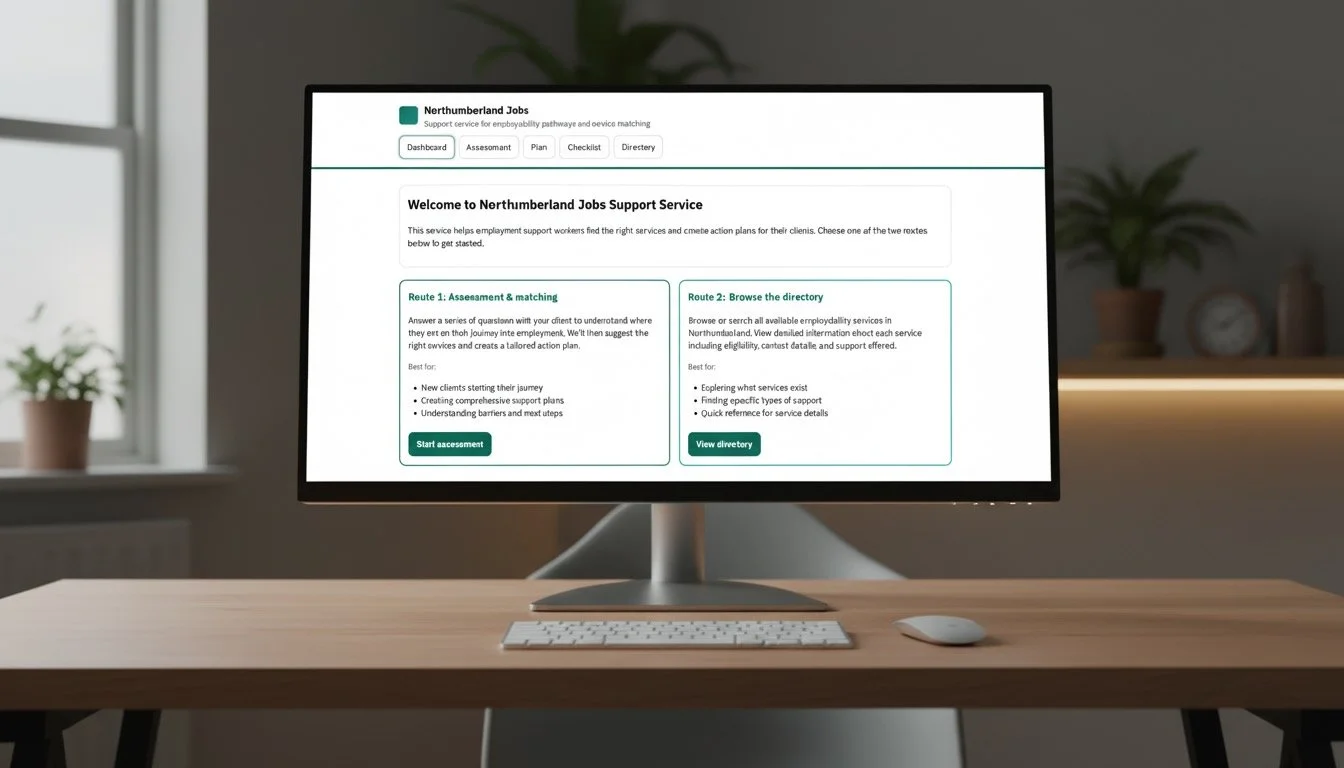
Early prototype of The Support Services Directory
We didn’t stop there.
We formed a series of diagnostic questions that would help identify where someone was on their journey, from not-working to working.
We defined the stages they could be in that process, starting at ‘not currently looking / unable to work, onto considering work, building readiness, right through to being ready for job searching and applications, interviewing and starting work.
We worked out the decision rules that would identify which stage people could be in, following their answers to the diagnostic questions.
By working through the questions with their client, employment support workers can quickly identify where their client is on their journey, and all the support services that would be useful to them at their current stage.
We tested this with some of the (brilliant) support workers. The feedback was good but highlighted a few potential updates were needed, so we iterated.
We added a way to create a checklist of actions — some assigned to the client, and some to the case worker.
All of this has been well received so far, by employment support workers, and identified as being ‘very useful’, so we’re continuing to develop this stream of work.
The next steps are to keep improving based on the feedback we’re getting from stakeholders and people using the tool.
Skills Needs Coordinator
During one conversation, we were told that organising training for clients across Northumberland can sometimes be a challenge.
We delved deeper into this and found that training providers often won’t deliver a course unless there is a required number of participants (usually 12 to 15 people).
Some courses run in centralised areas of the county, so rural residents find it hard to travel to attend them.
Imagine the scenario — one support worker has 3 clients in Wooler needing to undertake a health and safety course. Another support worker in Bellingham has 4 people needing the same course. And another in the south of the county has 5 more people needing the same course.
The support workers often don’t work for the same organisation, and therefore, have limited knowledge of other immediate training needs across the county.
So, we developed the Skills Needs Coordinator.
The idea was imagined by Julia at Community Action Northumberland, and we set about building the prototype for this.
Support workers from various organisations across the County can list the training they need to arrange for their clients.
Each training need is then shown on a central online page, alongside how many people currently need this training, where they are located, and how they can potentially travel there.
Once enough people are collated for the course to run, the platform notifies all the support workers who have listed their client’s need that a cohort can be filled.
To help with the transport planning, a visual map of people’s locations is displayed, so that training can be arranged in a location that makes most sense to deal with the transport required.
We’re in the process of testing and iterating this stream of work with the prototype.
From the feedback so far, we’re very confident that we’ll be able to make a big difference in helping people access the training they need, when and where they need it.
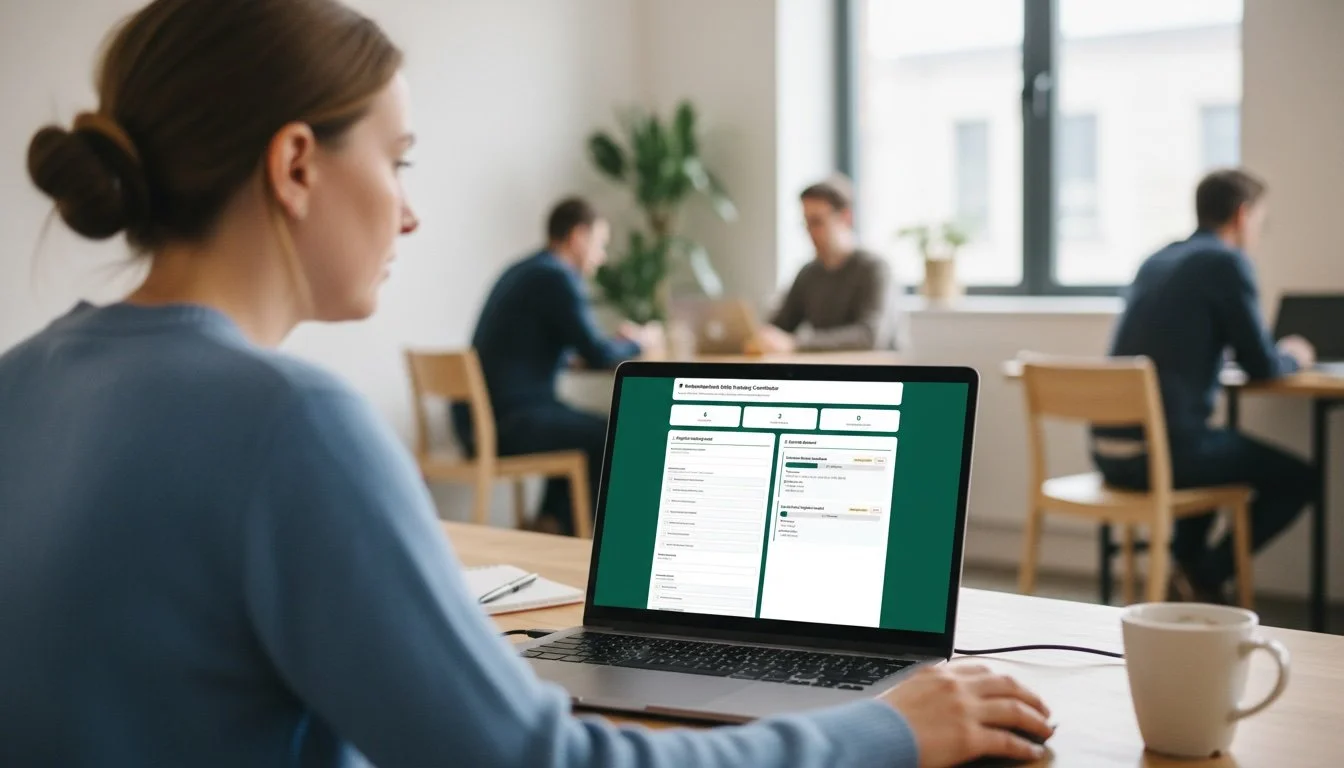
Early prototype of the Skills Needs Coordinator
Inclusive Job Advert Assistant
We’ve done a fair bit of work around skills and employment this year.
In the summer, we facilitated a design sprint on the future of skills for the Northumbrian Water Group at their annual Innovation Festival.
It was during that sprint that we became very aware of the difficulties people have when navigating the jobs market, especially around language and the understanding of words, phrases, and terms that are used by employers.
This difficulty is amplified for people who are new to looking for a job or haven’t worked for some time.
This means that many job listings aren’t as inclusive as they could be, which results in people who would be able to take on roles, not even considering or applying for them.
Bring in the rural context of living and working in Northumberland where transport needs are often not considered, and you have a perfect storm of challenging recruitment.
Which led us to another stream of the Rural Jobs Platform — the Inclusive Job Advert Assistant.
Having learned at the initial workshop about the brilliant work that Sam Spoors at Talentheads had undertaken for The Department for Education and the North East Chamber of Commerce with their Inclusive Recruitment Toolkit, we have started to work on developing a way for hiring managers, business owners, and anyone looking to recruit, to create more inclusive job adverts.
The Assistant guides the author through a series of steps to write their job listing.
At each step, there is guidance for writing inclusively, sense checking, bias checking and advice to ensure that the listing that comes out at the end is as inclusive and fit for a rural context as it possibly can be.
The idea is that, once created, the job listing would then be sense checked, and displayed as a searchable and filterable listing on a Northumberland-specific jobs board, or shared wherever else the employer would like to share it.
Again, we’re in development with this stream, and have plans to work closely with Talentheads, The National Centre for Ageing, Northumberland businesses, and unemployed people from across Northumberland to develop this further.
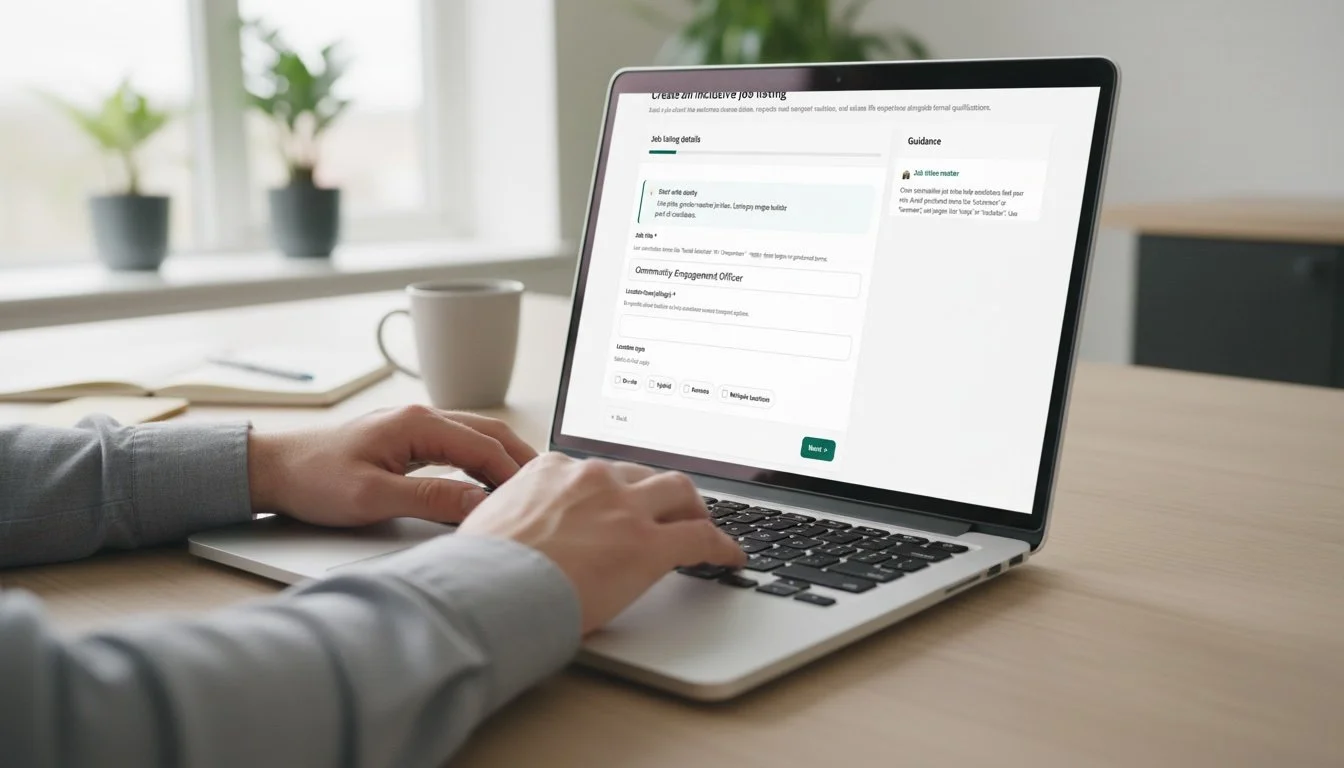
Landing screen of the Inclusive Job Advert Assistant
Job Matcher
There are a lot of job titles that don’t make sense to people looking for work.
Sometimes, job titles don’t convey what the job is about, which has the effect of less people applying for those roles, even though the people browsing these jobs could potentially do them.
Job titles such as ‘Festive Colleague’, ‘Team Member’, ‘Code Sensei’ and ‘Door knocking Legend’ are all job titles that are currently being listed. Ambiguous to say the least.
This has been a developing trend in the employment market for some time, and it’s not a helpful technique when recruiting.
We also know that there are job roles in various sectors that are emerging, which means that they are new job titles, and therefore not clearly articulated to people outside of those industries. As the workplace evolves and innovates, new industries and new roles are created.
Again, to someone who is new to the world of work, or just getting back into employment after a break, job titles that people haven’t heard of mean that less people will apply for them.
Which brings us to the job matcher. Not specifically a new concept, but instead of people looking at lists of job titles in adverts to see if they would meet their aspirations, people answer a short series of questions, such as:
What are you good at?
What are you interested in?
What skills do you currently have?
Once answering these questions, job seekers are then presented with a list of job opportunities that could suit their needs.
The job adverts have been created using the previously mentioned Inclusive Job Advert Assistant, so the language is non-biassed, makes sense, and is as inclusive as possible.
We’re in the very early stages of testing this prototype, but from early feedback we have received already, we’re optimistic that this will benefit people who don’t necessarily know what they are looking for in a job, can find opportunities to find work that is fulfilling, and meets their aspirations.
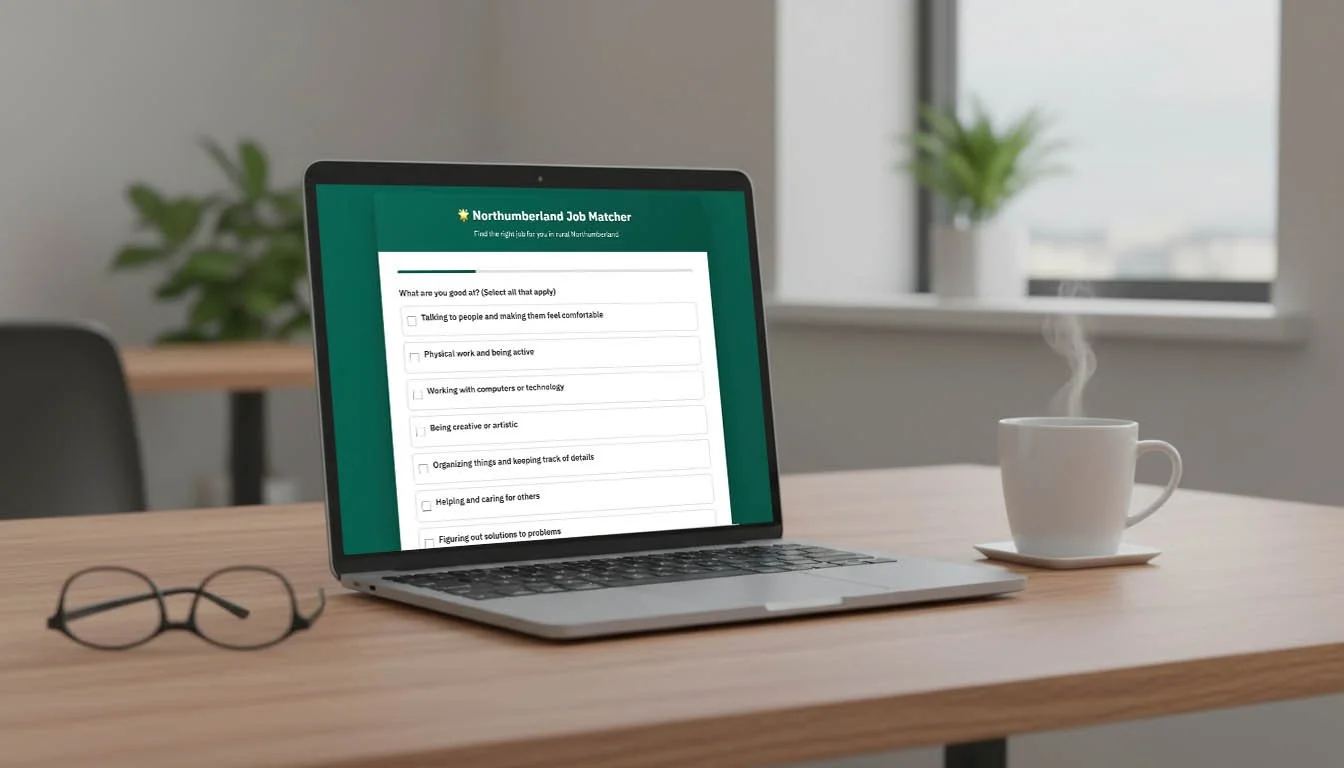
The Northumberland Job Matcher prototype
To wrap up
We’ve done some really interesting work so far, which we’re excited to develop further and make a difference to people moving into work, finding jobs, recruiting into their business, and those supporting all of the above.
Going forward we are also looking for the most effective way to resource the platform, and there is of course more testing and iteration to do.
Want to be involved?
As you can probably tell, we’re all up for collaborating, so if you’d like to be included in the conversations, co-design or any part of this project, then get in touch on our contact page, or keep an eye on the Rural Jobs platform website.
Thanks to everyone who has helped so far
A big thanks to all of the people and organisations that have contributed to this project so far:
Maria Antoniou, Sarah Kidd, Vicki Clarke, Mick Burton, Vanessa Laing, Alex Black, Claire Wickens, Neil Dorwood, Debbie Allman, Rebecca Thompson (Northumberland County Council)
Julia Plinston (Northumberland Rural Employment Hubs, Rural Aspirations, Community Action Northumberland)
Gillian Gordon (Rural Aspirations, Glendale Gateway Trust)
Sam Spoors (Talentheads)
John Harrison (Solidarity Farm)
Lyn Horton, Caroline Rogan, Nathan Miller, Angela Irving, David Gravell, Julie Fox, Martin Conway (Northumberland Community Voluntary Action)
Zoe Maylam, Liz Mayes (Connect Northumberland)
Lucy Evermore (Business Northumberland)
Luke Dargie (Bernicia Homes)
Alistair Wathey (The Alnwick Garden)
Julie Philips (Northumberland National Park)
Sharon Campbell-Lawton (Newcastle Gateshead Initiative)
Mary Blackwell (Groundworks North East)
Tracy Girdwood (Northumberland College)
Tracey Jackson (Land and Nature Skills Service)
David Hall, Michelle Todd-Davison, Kelly Wardley, John Burluraux (Northumbrian Water Group)
Steve Byard (Arcinova)
John King (NBSL)
And of course the funders 😊
This project is funded by the UK Government through the UK Shared Prosperity Fund and the North East Combined Authority Investment Fund with the North East Combined Authority as the Lead Authority”
